

Wisdom in Challenging Times
Psalm 23
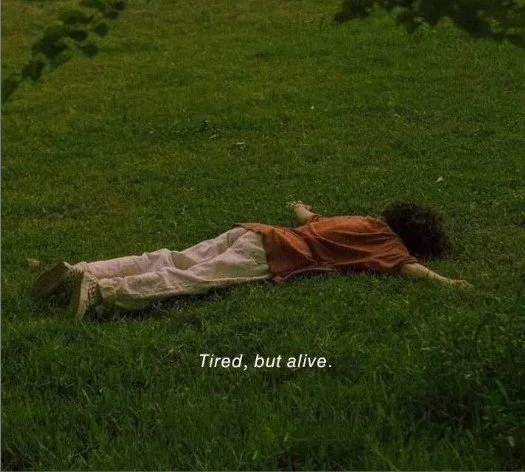
This image of a person lying in a field says “tired, but alive.” Is that anyone, here?
Psalm 23 (NRSV):
1 The Lord is my shepherd; I shall not want.
2 He makes me lie down in green pastures;
he leads me beside still waters;
3 he restores my soul.
He leads me in right paths
for his name’s sake.
4 Even though I walk through the darkest valley,
I fear no evil,
for you are with me;
your rod and your staff,
they comfort me.
5 You prepare a table before me
in the presence of my enemies;
you anoint my head with oil;
my cup overflows.
6 Surely goodness and mercy shall follow me
all the days of my life,
and I shall dwell in the house of the Lord
my whole life long.
Let’s start with a little exercise. I’d like you to, first, remove your shoes and socks and put them in the lap of the person sitting closest to you.
No, here’s the exercise: I’m going to start a sentence and you can finish it with whatever feels to you like the right word or phrase. Just say it aloud wherever you are.
When you’re hungry, you need ( ).
When you’re tired, you need ( ).
Ok, those were pretty straightforward.
When you’re sick, you need ( ).
When you’re stressed, you need ( ).
When you notice yourself snapping at others, you need ( ).
When you’re doubting the gifts others recognize in you, you need ( ).
When you’re being continually hurt by someone or some group, you need ( ).
When you’re lost, you need ( ).
When you’ve been doing all the talking, you need ( ).
When you need help, and those with you can and want to help...you need ( ). “To stubbornly refuse help, ’cause that’s weak,” is the sense of the room. Fascinating! :)
We’re talking more or less about our word of the year: sustain. How do we get the thing we need, so that we can keep going?
You know this scripture. Maybe from funerals, where it’s often read as a source of comfort, or from inspirational posters on walls, or from movies, even. Psalm 23 offers reassurance that we’ll be okay, we’ll get through this, and we’re not alone.
On a theological level, the speaker is telling us some things they believe about God. On an experiential level, the speaker is telling us what they need.
I don’t think the Psalmist was a Quaker–unless they were a time traveler–but I do think they share the traditional Quaker commitment to deep listening. I suspect that the experience that produced this beautiful Psalm started with an awareness of their own reality, and their own doubts. They are going through something difficult, maybe unique to them or maybe shared with a group. Are they going to make it through? Are they capable of making it through?
To find answers to those questions, the Psalmist listens to the wisdom they already possess. They listen to their body. To their lived experience. To the voices of others they carry with them, always. To accumulated and relevant knowledge. They listen to their own story. They listen to Love. To Divine Presence within. And while they credit God as their provider, restorer, guide, protector, comforter, their home…they’re not naming these truths for God’s sake. God doesn’t need reassurance. The speaker needs reassurance. And so they are listening to their life, to the way the Divine has taken up residence in their bodies, in their lives, providing them the internal and external resources they need to sustain them. They’re telling themselves: it’s going to be okay.
How do you reassure yourself? You all face difficult things. Do you ever notice yourself turning inward for the wisdom and courage you need to navigate something difficult? Maybe you don’t always consciously do it, but maybe there are things you know you need to hear, that you most need to hear, not from God, or others, but from yourself?
I asked myself this past week, what do I tell myself, in challenging moments? Let me give some examples of wisdom that may have come to me as grace–as gift–but speaks to me in my own voice:
You don’t have to figure this out by yourself.
It doesn’t have to be perfect.
Your calf muscles are otherworldly.
You have so much time to accomplish your goals.
You’re not an imposter, you belong here.
Please don’t forget to laugh at yourself, you silly, silly boy.
You fixed your gate, you can fix things.
You fixed your leaky roof, you can fix things.
You couldn’t fix that mess you made in Kindergarten when the robin’s egg you brought for show and tell exploded on the Easter greeting cards your classmates made and your teacher yelled “Matthew!” in anger and disappointment…but that clearly traumatic experience…doesn’t negate the fact that you are a person who can fix things.
Sometimes we need the reassurance of others, or God. But we don’t live life in a vacuum. We might lack some knowledge that can be gained from a book, or a smart friend, or a DIY Youtube video, but we’ve gained so much wisdom already from people, from God, from practice, from success and failures, that if we listen to ourselves, carefully, we might realize we contain the truths within us that we need to sustain us.
What wisdom do you possess? Are you listening to that wisdom? What truths do you tell yourself, to reassure yourself, to help sustain yourself through challenging times?
Of course we’re not alone. We don’t get the sustenance we need apart from the Divine Ecosystem of which we are a part. God sustains us. Earth sustains us. Systems we’ve created–some of them–sustain us. Our friends and family sustain us. Sometimes a kind stranger, seeing us on the roadside, so to speak, lends a hand, and sustains us.
And yet I think whether we notice that sustenance, whether we find it, seek it out, whether we welcome it when offered, whether we open our hearts and minds to it, with humility and vulnerability, depends a lot on us. Most people can’t really make us lie down in a green pasture. We’re the ones who have to make that happen.
The Psalmist is attending to the wisdom they possess about what they need. And in a way, more than a song of praise to a Deity out there, it is a song of self-affirmation, of self-assurance, of trust in themselves and the Divine within.
Consider the Psalmist’s noticings. The Psalmist says more or less, I’m in it, I’m going through something that feels daunting. Nevertheless the Psalmist says…
I have what I need and I have others who can help me get what I need. I can go lie down in a meadow and close my eyes. I can go sit by a lake, and breathe. I can do what is restorative.
I am capable, with help from God and/or others–utilizing what I know and what others can help me discover in myself–of finding a right path, a way forward. I can go where things are dark, that is to say, I’m capable of walking into mystery and uncertainty and even challenging but necessary transformation, and coming out okay on the other side. I can venture forth, knowing I’m protected. My community has my back.
I can bravely face my enemies, because they don’t get the final word on me and my life. I am anointed, that is chosen, to be me, and nobody else can do the job of being me, like I can. My cup overflows, I have so much, we…have so much.
I will be okay because people will relentlessly do good things for me and show me mercy. I will be okay, because I can live not in the house of greed and violence and cruelty and, but in God’s house, which is not in the sky but here–it is the house of Love.
Maybe you cannot personally make all of the self-affirmations the Psalmist voices, here. So, then, “what canst thou say?”
As is often the case, God, here, is something of a model. In the same ways God sustains the Psalmist, they are invited to sustain others. As Friends, who persistently affirm that of God in each other, we can recognize that Love calls us in many good directions: inward, as we need sustenance, and outward, as we participate in sustaining others.
We can make sure people don’t lack what they need. We can help people find rest and restoration. We can help people find their paths. We can accompany people through times of uncertainty. We can comfort. We can work with people to prepare a table, not just space at a table their enemies built and set, but a new, bigger table, built together. We can feed, quench, and shelter. We can show mercy. We can guide people toward God’s house–not a building, but anywhere people are well-acquainted with Love.
Maybe we are all praying some form of this prayer, singing some form of this Psalm, right now, no matter the challenge we face. You may be your own truth-teller. What are your lyrics? What truths about yourself, God, and your community, are you clinging to, to sustain you? What reminders, what affirmation, what nudge do you need, from yourself? And maybe it’s a forceful nudge. Sometimes a spacious invitation doesn’t work and you need to make yourself lie down in a field, or find those still waters.
And maybe others are praying this prayer, whether they call it prayer or know it’s even happening. How can we participate in sustaining others through their challenging time?
I invite you to recenter on the Love within you and within the people in this room, and remember that this Love is yearning to be awakened and nurtured and guided toward action. So listen to your Guide. Listen to your needs. Listen to your vulnerabilities. Listen to your fears. Listen to your community. Listen to your noisy, hungry tummy. Listen to your noisy hunger for peace and justice. Listen to the abundance within and around you. Listen to the goodness within and the goodness following you around, every day. Listen to the Love that is your Center, your Home, a good place to dwell your whole life long.
Queries:
What sustains you through challenging times?
Where do you find the Divine in challenging times?
What wisdom do you possess that can help you, or us, in the challenges we are facing?